
6 min reading time
From Setup to Success: Bridging the Gap Between Onboarding and Value

What you’ll learn:
- The Onboarding vs. Activation Framework: Why technical setup is the foundation, but education is the catalyst that transforms a “set-up” user into an “activated” champion.
- Customer Education as a Revenue Driver: How shifting learning from a support function to a strategic initiative directly increases Net Revenue Retention (NRR).
- Closing the Competency Gap: Why users churn despite 100% onboarding completion, and how to build the Professional Confidence required to prevent “silent churn.”
- Performance Metrics: How to transition from vanity metrics (clicks and views) to high-impact indicators like Behavioral Change and Time-to-Value (TTV).
Let’s be real: we’ve all felt that surge of pride seeing a 90% onboarding completion rate. You’ve built the courses, the welcome emails are hitting inboxes, and those little green checkmarks are appearing exactly where they should. And you should celebrate—onboarding is the vital foundation. It’s the solid path for everything that comes next.
But, in a market where Net Revenue Retention (NRR) is the “holy grail” metric, a “set-up” customer is just at the beginning of their journey. If onboarding builds the house, then education turns the lights on, transforming the technicality of logging in into the strategic victory of seeing results.
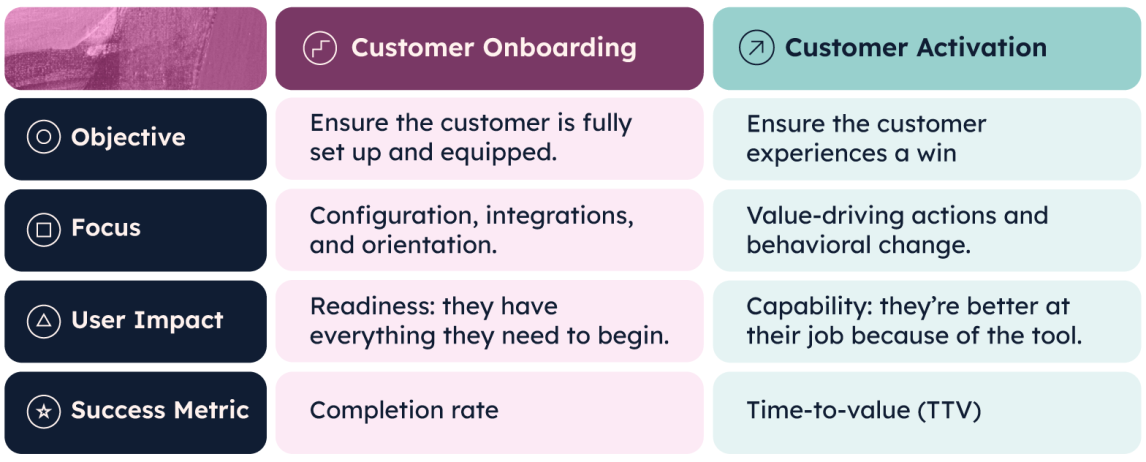
This is the core shift: Your users don’t sign up to learn a tool; they sign up to solve a problem. Let’s say that their goal is to reach a summit. If we look at it through that lens, customer onboarding is the basecamp (providing the gear and the map), while customer activation is the arrival. It’s that breakthrough moment where your customers finally see the view they climbed for.
But the truth is, the gear and a map alone won’t get them to the peak. They need a mountain guide to teach them the specific techniques to navigate the journey and reach the top safely. And here’s where Education comes in.
Onboarding and Activation: The Path to Value
To master your customer education strategy, the first step is to stop treating onboarding and activation as separate silos. Instead, start thinking of Customer Education as the connective tissue between them.
Onboarding is the Functional Start
Customer Onboarding ensures the account is ready and your user understands the interface of your product. This “readiness” is crucial, since there’s no successful user without a complete and accurate setup. It’s the structural foundation that makes everything else possible.
Activation is the Strategic Realization
This is the successful outcome of that foundation. It’s the moment the customer moves from being just prepared to being capable.
The Competency Gap: Why Setup Isn’t Success
So, why do high completion rates still lead to churn? It’s often due to the Competency Gap. A user can be perfectly set up—fully onboarded—but still feel a bit hesitant about how to translate those new tools into real-world results. They know where the buttons are, but they don’t have the professional confidence to drive results just yet.
And this is where education steps in. It bridges that final gap by shifting the focus from clicks to confidence, turning a prepared user into a self-assured champion.
The “Aha!” Moment: Where Confidence Meets Capability
Every product has a unique core value milestone—the point where a customer moves from “I’m set up” to “I’ve got this.” This is known as the “Aha!” Moment, the first real breath of air at the summit.
While a customer who completes their profile has taken the first step, they aren’t truly activated until they feel the impact on their daily work. The goal of customer education here is simple: to bridge that gap.
However, the summit looks different for every single climber. An Executive’s “aha!” moment might be the first time they see a high-level ROI dashboard, while an admin’s win is the first time a manual task is automated. Different roles, different goals.
And there’s a catch: if a user doesn’t hit their personal version of success within the first 14 days, the risk of “silent churn” increases. And that’s why a milestone-driven, personalized process, fueled by proactive education, ensures that the momentum from a smooth onboarding carries them all the way to that first, specific “aha!” moment.
But how do we ensure every user beats that 14-day clock? Simple: by making the journey personal.
Personalization: The Engine of Value Acceleration
This year, personalization has evolved far beyond just adding a customer’s name to a welcome email. The key word here is relevance. To help your customers reach the summit of activation efficiently, personalization acts as the direct journey through the cognitive noise, so users spend their first hours and days experiencing value, rather than searching for it.
The shift we’re experiencing is away from “one-size-fits-all” and toward tailored enablement, since personalization is now a strategic necessity. By understanding that different roles need different shortcuts to their specific “aha!” moments, you make sure that onboarding feels like a specialized fast-track to success.
Personalization supports activation in three distinct ways:
1. Aligning with Individual Success Metrics
Personalization allows the courses in your academy to mirror the customer’s specific needs and goals. Instead of a “one-size-fits-all”, personalization creates a “Just-in-Time” learning loop that reacts to the user’s journey. For example:
- The Feature-Led Trigger: When a user interacts with a core tool for the first time, your system can automatically suggest a module on Advanced Insights. You’re teaching them how to turn the data they just entered into the results their stakeholders expect.
- The Plan-Based Path: By filtering content based on your user’s subscription tier, you ensure they only see the tools they can actually access. This keeps them focused on the value they’ve already paid for, rather than being distracted by “feature FOMO.”
- The Use-Case Shortcut: If a user’s goal is team efficiency, their path should bypass solo-user guides and jump straight to Shared Workflows. You are cutting the time-to-value by removing every bit of “noise” that doesn’t apply to their specific mission.
By tailoring the experience this way, the customer isn’t just completing a task—they are achieving a milestone that holds real-world value. It’s a true win-win: your customer gains professional confidence, and your business secures a long-term champion.
2. Enhancing Focus Through Relevance
By surfacing only the tools and content relevant to a customer’s specific function, you remove the friction. No more searching for what matters to them individually! You’re giving them the exact “climbing technique” they need for their specific journey instead of a manual for the whole mountain.
3. Scaling the “Journey to Mastery”
Personalization ensures the transition from initial setup to ongoing enablement is seamless. By recognizing a customer’s history and goal (knowing what they’ve mastered and what they still need to learn) you create a continuous learning journey. This allows you to scale activation across thousands of users.
The ROI of the Activated Learner
When a customer reaches their personal summit, the business reaches a financial one. For B2B SaaS companies, an activated learner is one of the primary predictors of NRR. The reason is simple: when we shift the goalpost from “how much they learned” to “how fast they won,” we create a momentum that ripples across the entire customer lifecycle:
1. A Natural Path to Expansion
Personalized education does more than just teach the basics—it creates a bridge to the features that solve the customer’s next problems. By showing them what’s possible, your academy becomes a natural engine for growth and expansion. Because once they’ve conquered one peak, they’re ready for the next one!
2. Strengthening the Renewal
When a customer is activated early, the product becomes an essential part of their daily workflow and professional habits, shifting the way your product is seen: from a “line item” into a “necessity.”
This deep integration is what drives Net Revenue Retention. Why? Because when a team relies on your product for their data and daily routines, the cost of switching becomes higher than the cost of staying. Since companies with an NRR over 100% grow significantly faster than their peers, these early habitual wins are the first steps toward long-term financial health.
3. Addressing “Silent Churn” through the Competency Gap
Silent churn happens when a customer is technically onboarded but hasn’t yet felt the personal win of the product’s value. They have the gear, but they haven’t started the climb.
By focusing on activation milestones—like the time it takes to complete a first role-specific certification—you can measure customer confidence in real-time. This allows you to identify and support at-risk accounts weeks before they become a churn risk, turning a potential drop-off into a moment of proactive enablement.
The 2026 Mandate: Customer Onboarding + Activation
If your strategy ends at onboarding completion, you’ve probably built a great foundation, but you’re only at the beginning of the customer’s potential.
This year, the companies that lead the market won’t necessarily be the ones with the most features. They will be the ones who empower their customers to succeed the fastest. By treating onboarding as the crucial foundation and education as the engine of activation, you turn users into long-term partners in success.