
6 min reading time
How a Customer Onboarding Platform Fast-Tracks Time-to-Value

What You’ll Learn From This Blog:
- The Scaling Trap: Why manual, 1:1 training burns out CS teams and drives up support overhead.
- The Centralized Hub: How onboarding software untangles a fragmented stack of Slack and Zoom.
- Tech Stack Harmony: How syncing with different tools turns training into a revenue driver.
- The ROI Framework: How to prove the fiscal impact of customer education directly to the C-suite.
- AI Acceleration: How to build high-impact micro-courses in minutes without a large content team.
In today’s fast-paced SaaS world, getting customer onboarding and digital onboarding right is crucial. A seamless initial experience sets the tone for the entire customer relationship. But here’s the catch: if you’re trying to scale that experience through manual, 1:1 training and endless support calls, you already know it’s a losing battle. It drains your internal resources, burns out your Customer Success (CS) teams, and ultimately leads to low feature adoption and stalling accounts.
To break out of this reactive mode, forward-thinking CS, Marketing, and Revenue leaders are ditching manual interventions and investing in structured Customer Academies. Why? Because moving to a dedicated customer onboarding platform, a modern onboarding software, transforms customer education into a scalable, ROI-driven growth engine.
What Exactly Is a Customer Onboarding Platform?
Think of a customer onboarding platform as your digital welcome committee, educator, and guide all wrapped into one. Its main job is to help new users find their footing in your software smoothly, taking the repetitive heavy lifting off your CS team’s plate.
Instead of forcing users to rely on a fragmented stack of messy Slack channels, ad-hoc Zoom calls, and buried help desk articles, these platforms bring the entire onboarding experience into one clean place. Acting as a user onboarding platform, they use interactive tutorials, structured learning journeys, milestones, and in-depth walkthroughs to ensure new customers quickly understand how to get the most value out of your product.
Plus, they put routine training tasks on autopilot. Here is what you get out of the gate:
- A consistent experience for every single account, whether they are mid-market or enterprise.
- Smart automation for repetitive tasks like basic feature walkthroughs and initial setup.
- Deep insights into user behavior and learning progress before they hit a renewal roadblock.
Why Customer Onboarding Matters
Good onboarding is all about helping users win early and often. It completely dictates how a customer views your software and directly impacts your bottom line.
When a B2B SaaS company scales fast, the gap between a customer buying a highly technical product and actually realizing its value can get dangerously wide. A well-structured digital onboarding process closes that gap. This accelerated time-to-value keeps users engaged, driving higher customer satisfaction, negative net churn, and predictable account expansion.
At the end of the day, great onboarding is a massive competitive advantage. It keeps early-stage drop-offs low and customer lifetime value high. Here’s what a robust academy can achieve:
- Smarter learning: Replaces overwhelming documentation with digestible, structured learning journeys.
- Proactive retention: Lowers customer churn by tackling adoption hurdles before they become problems.
- Brand advocacy: Builds long-term loyalty and turns everyday power users into certified brand champions.
The Key Features to Look For
Modern onboarding platforms and onboarding solutions come packed with features designed to simplify learning and streamline your operations without forcing you to add headcount. If you’re unsure about what to look for, here’s a breakdown:
Onboarding Automation & Customization
Onboarding automation takes care of the busywork, like welcoming a new customer or assigning their first introductory course, instantly. From there, customization lets you tailor the journey for different user roles. You can ensure an executive gets high-level dashboard training while an admin dives deep into technical configurations.
Tech Stack Integrations
To get real ROI, your customer education platform shouldn’t live on an isolated island. It needs to talk to the tools your team uses every day, including your customer success platform:
- CRM (such as HubSpot): Sync learning data to see exactly how course completion impacts your sales pipeline and account health.
- CS Tools (such as Intercom & Planhat): Auto-suggest training modules right where you engage users, and trigger health playbooks the moment an account hits a learning milestone.
- Communication (such as Slack): Send automated learning milestone alerts and notifications directly where your teams or customers already communicate.
Teams often pair the platform with client onboarding tools to standardize handoffs, improve continuity between teams, and ensure customers receive a consistent onboarding experience from initial setup through adoption. Let the tech talk!
The Top Benefits of Taking the Leap
Moving into a dedicated platform streamlines the onboarding experience, making it highly effective and infinitely scalable.
It allows your CS managers to step back from running the same basic training sessions over and over again, and let them focus on what they do best: strategic account management and expansion.
1. Streamlined and Automated Processes
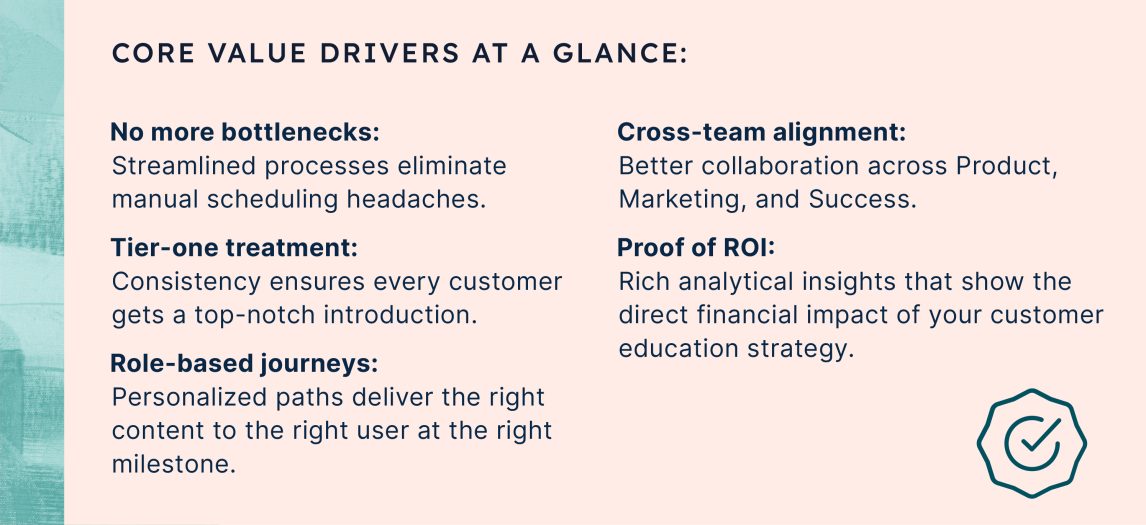
Automation takes over the repetitive tasks, dramatically reducing human error. With automated workflows handling the basics, your team is freed up to focus on higher-value milestones, boosting internal productivity, getting customers activated faster, and lowering your overall cost to serve.
2. Consistent and Personalized Journeys
A dedicated platform guarantees brand integrity by giving every customer a high-quality experience. At the same time, audience segmentation lets you personalize the journey based on user needs, making your customers feel understood and driving deeper product adoption. Domino effect!
3. Better Customer Retention and Lower Churn
It’s simple: customers who know how to use your product are happier and stay longer. This strategy drives lower churn rates by handling friction points early. When you can see exactly where users are getting stuck in a learning journey, your team can step in proactively, long before a bad CSAT score or a missed renewal happens.
4. Effortless Team Collaboration
By centralizing all your learning data, these platforms keep everyone connected. When your academy syncs with your CRM and help desk, Sales, Product, and Success all stay on the same page regarding an account’s progress, leading to faster problem resolution and better service.
5. Actionable Insights You Can Take to the C-Suite
Data-driven insights are a game-changer. By cross-referencing learning progress with actual product usage, you can finally answer that ultimate leadership question: “Is the ROI worth it?” Showing that trained accounts have higher health scores than untrained ones transforms your academy from an internal expense into a certified revenue driver.
How to Choose the Right Platform
Finding the right platform means aligning its features with your team’s technical maturity and unique goals. Start by identifying your biggest current friction points—whether that’s a massive spike in support tickets or low feature adoption.
As you look at your options, keep this quick checklist in mind:
- Smart onboarding automation for easy user creation, enrollment, and quick reminders.
- Flexible targeting to tailor experiences for different customer segments or tiers.
- Native integrations with your tech stack (HubSpot, Intercom, Slack).
- Clear analytics frameworks for straightforward leadership reporting.
- An intuitive interface with easy content authoring so your team can hit the ground running.
Best Practices for Maximizing Your Success
Building a great academy requires a bit of strategy, just like everything ese. The goal is to create an engaging digital journey that does a good job complementing your high-touch success efforts.
Here’s a checklist:
- Aim for quick wins: Set clear, bite-sized milestones so users don’t get overwhelmed.
- Keep communication human: Tie academy reminders to real-world value, not just feature checklists.
- Listen to the data: Use short feedback surveys to find and fix underperforming training modules.
- Never stop educating: Transition initial onboarding smoothly into ongoing product enablement and advanced certifications.
Real-World Impact: What Success Looks Like
Moving from manual training to scalable customer academies pays off fast.
For example, teams have seen a 18% drop in support tickets simply by replacing manual kick-off calls with automated, structured learning journeys and the HubSpot integration. Other organizations have boosted expansion and upsell opportunities by using targeted certifications to introduce advanced product features. These kinds of results show the definitive impact an onboarding strategy can have on driving business growth, cutting support overhead, and keeping customers happy.
A great customer onboarding platform bridges the gap between closing a sale and ensuring long-term customer success. By investing in a digital-first academy and connected onboarding solutions, you pave the way for predictable, scalable growth, making sure your customers get the value they paid for while building a base of long-term advocates.
Pragmatic Next Step
Audit your last 10 customer support tickets. Take a look at how many of them stem from basic, repetitive setup questions. If more than 30% of your tickets are purely educational, map out a 3-course micro-learning journey that can automate those answers for your next cohort of customers.
With LearnUpon, you don’t need a massive content team to pull this off. You can leverage Create+, LearnUpon’s built-in AI authoring tool, to instantly ingest your existing technical documentation, release notes, or FAQs, and generate polished, interactive micro-courses in minutes.
Ready to turn your onboarding experience into a scalable growth engine?
You don’t have to choose between scaling fast and giving your customers a tier-one experience. Build a Customer Academy that reduces your support overhead, accelerates time-to-value, and protects your retention revenue.
See how LearnUpon can transform your customer onboarding.