5 min reading time
Cut Churn with a Customer Education Platform

What You’ll Learn
- The Support Strain: How a customer education platform moves your CS team out of firefighting mode and reduces overall support costs.
- Onboarding Optimization: How structured customer onboarding solutions shorten time-to-value and lower initial churn rates.
- Feature Deep-Dive: The essential tools to look for in a customer education LMS, from tracking analytics to organizing B2B customer education academy categories.
- The Loyalty Loop: Why empowering users with self-service resources turns everyday customers into long-term brand advocates.
Scaling Content with AI: How to build interactive micro-courses instantly using your existing documentation and Create+.
As a B2B SaaS company scales past its first thousand customers, growth usually triggers a painful reality check. Your Customer Success managers find themselves trapped in an endless loop of repetitive, manual customer onboarding calls, while your technical support queue overflows with basic tickets. Sound familiar?
The thing is, when you’re growing fast, relying entirely on high-touch training is a direct bottleneck to your revenue margins.
Transitioning from a disparate mix of Zoom recordings, Slack channels, and static help docs to an intentional, digital-first strategy is, indeed, about organizing content, but also about building a scalable engine that accelerates growth. A dedicated customer education platform—customer education software often delivered as a customer academy—transforms how your customers interact with your software, shifting them from casual users into deeply retained product champions.
What Makes a Customer Academy?
A customer academy is a digital solution that educates your customers. It serves as a centralized hub where businesses can host educational content for their users, which helps them understand your products better and use them effectively.
These academies can include various learning tools and resources, such as video tutorials, interactive modules, and assessments. A combination of these elements engage customers and make learning a dynamic experience for those who come across your educational content.
These platforms, often delivered as a customer education LMS, streamline the learning process for every single customer. They provide easy access to resources, at any time, which ends up enhancing customer satisfaction and retention. Think about it: Instead of waiting on a CS manager to schedule a call, customers can learn at their own pace, reducing the need for constant support.
And that’s how a customer education platform can also reduce support costs. By empowering customers to find solutions independently, it builds customer confidence early in their lifecycle. And your team? Well, they can focus on growth and more advanced tasks.
Besides, a customer academy can offer valuable insights. Built-in analytics tools track customer progress and engagement, helping businesses refine their learning strategies, ensuring continuous improvement.
Adopting a customer education platform benefits both businesses and customers:
- Customers gain valuable knowledge and confidence.
- Businesses enjoy enhanced customer satisfaction and reduced support demands.
As digital solutions evolve, these platforms remain essential for companies aiming for competitive advantages.
Key Features of Customer Education Platforms
As you might have gathered by now, customer education platforms come with a variety of robust features to better support customer needs.
At the core of many customer education platforms is a Learning Management System (LMS), which enables structured course delivery, learner progress tracking, customized learning journeys and reporting.
In this context, interactive content plays a key role in keeping customers engaged. Videos, quizzes, and interactive modules make learning more enjoyable, while also allowing content to be tailored to different learning styles.
Alongside, analytics and reporting tools add another layer of value by providing clear insights into customer progress and highlighting knowledge gaps, which can be addressed after analysis to make the learning process even easier to the learner.
Together, these features create a seamless learning experience. The result? A customer education platform that delivers more effective training, supporting ongoing customer development and ultimately boosting satisfaction and loyalty.
How Customer Education Platforms Enhance Customer Onboarding
When we talk about customer education, it’s safe to say that customer onboarding is crucial for its success. A well-structured onboarding experience can set the stage for long-term customer satisfaction, and customer education platforms play a pivotal role in this process as a customer onboarding solution.
These platforms give new customers easy access to learning resources, helping them quickly understand your products or services. By learning at their own pace, they can reduce time-to-value and become productive faster than ever before.
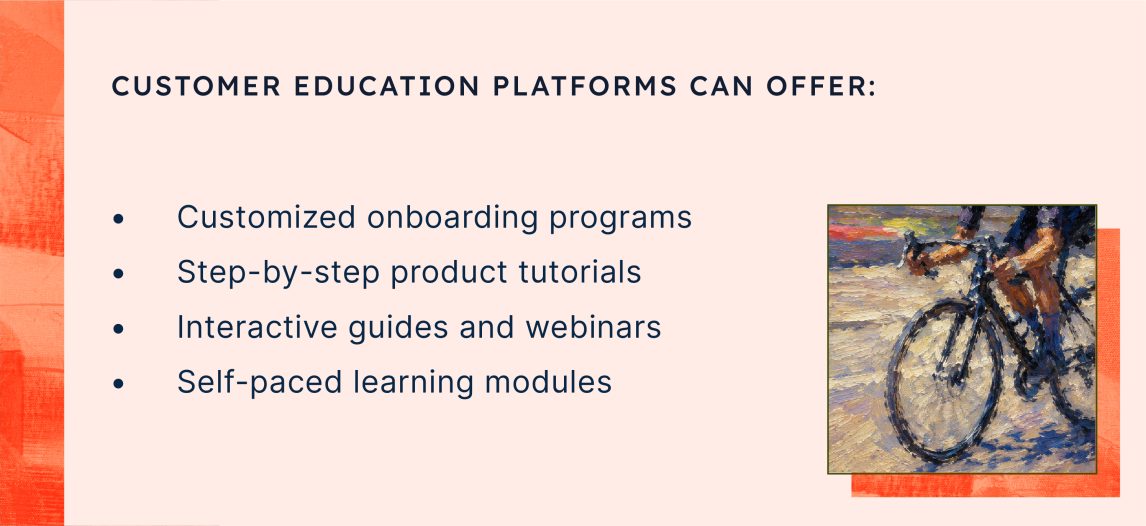
By strengthening the onboarding experience, customer education platforms can also help reduce churn. When customers feel empowered from the start, they are more likely to stay engaged, remain loyal, and see ongoing value in the product. As a result, businesses benefit from higher retention and improved satisfaction rates. And churn scores? They keep on decreasing.
Improving Customer Support and Reducing Costs
As a consequence of empowering users to find the answers they need on their own, customer education platforms significantly reduce the workload to customer success teams, leading to fewer support interactions overall.
This self-service approach helps minimize support costs. With fewer routine tickets coming in, support teams can focus their time and energy on more complex, high-value issues, improving both efficiency and customer satisfaction.
Key ways these platforms reduce support strain include:
- Providing self-service resources
- Offering 24/7 access to help guides and learning materials
- Encouraging community forums for peer-to-peer support
Scalability and Flexibility for Growing Businesses
A customer education platform is built to scale alongside your business. As your customer base grows, it can accommodate increasing numbers of users, ensuring your programs remain effective regardless of company size. No bottlenecks!
Flexibility is another key advantage. Whether you’re launching new products or expanding into new markets, the platform can easily adapt to evolving education needs, helping you maintain a competitive edge.
Key aspects of scalability and flexibility include:
- Supporting a growing number of learners
- Seamless integration with new tools and features
- Customizable learning journeys for diverse audiences
By leveraging a customer education platform, businesses can keep their educational programs aligned with growth, delivering consistent, high-quality learning experiences at every stage of expansion.
Integrations and Ecosystem: Maximizing Value
A robust customer education platform integrates seamlessly with other business tools so its information isn’t siloed. As an online learning platform, it becomes even more powerful when connected to systems that extend its capabilities. For example, integrating with CRM such as HubSpot systems allows data to flow between platforms, enabling more personalized and relevant training experiences.
By maximizing value through an integrated ecosystem, businesses can deliver a more cohesive learning experience. This leads to stronger customer relationships, improved engagement, and better outcomes.
Best Practices for Implementing a Customer Education Platform
Successfully implementing a customer education platform requires thoughtful planning and a clear strategy from the outset.
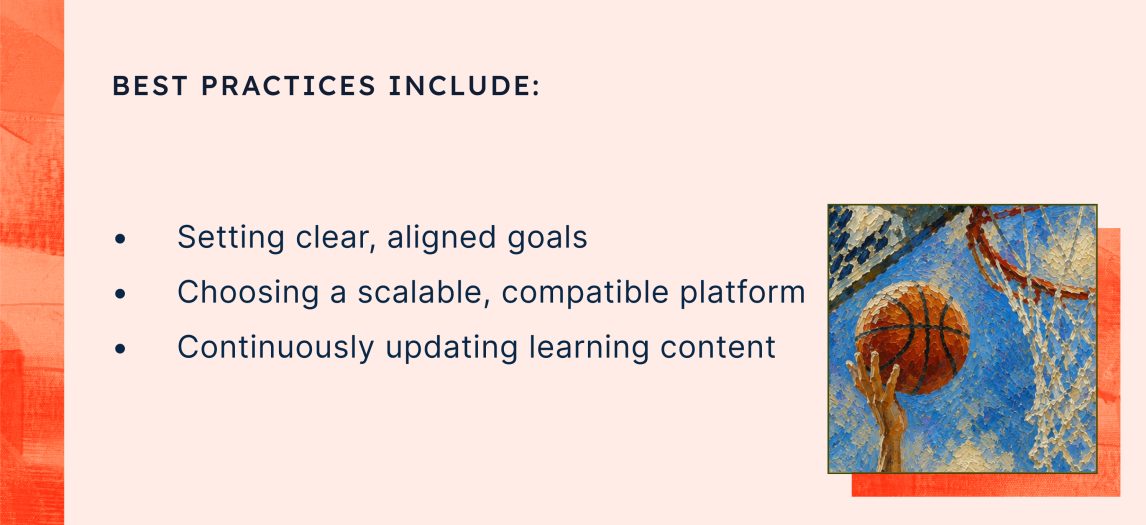
Need help to start? Kick-off the process by defining clear goals that guide the rollout—these should align closely with both your business objectives and your customers’ learning needs.
Next, prioritize selecting a platform that meets your technical and operational requirements. Consider factors such as scalability, integration capabilities, and support for multiple learning formats to ensure it can grow and evolve with your organization, including whether it can operate as a customer education LMS.
Finally, make content maintenance an ongoing priority. Regularly updating and reviewing learning materials ensures they remain accurate, relevant, and engaging. AI tools like Create+ can be extremely useful when updating your ever-changing content. Actively encouraging customer feedback can also help identify areas for improvement and drive continuous refinement.
By following these principles, businesses can fully unlock the value of their customer education initiatives and create a more impactful learning experience.
Conclusion: Why You Should Invest in a Customer Education Platform
Investing in a customer education platform can easily transform how you engage with your customers.
It not only helps customers become more confident and loyal but can also significantly reduce the burden on support teams. By enabling users to find answers independently, it lowers the volume of support tickets and promotes a more efficient, self-service approach. This not only drives cost savings but also improves the overall quality of customer support teams.
In addition, a strong customer education strategy enhances your brand reputation. It signals a clear commitment to customer success and continuous improvement, positioning your business as a trusted leader in your industry.
Key reasons to invest:
- Enhances customer experience
- Reduces support costs
- Strengthens brand reputation
Investing in a customer education platform ultimately helps create more empowered customers—and a stronger, more scalable business.
Ready to turn your customer education experiences into a scalable growth engine?
You don’t have to choose between scaling fast and giving your customers a tier-one experience. Let’s build a Customer Academy that reduces your support overhead, accelerates time-to-value, and protects your retention revenue.