8 min reading time
Beyond Administration: How Agentic AI is Redefining L&D Roles

What you’ll learn
- The Shift to Impact: How a deliberate approach to AI and agentic learning software transforms L&D from an admin function into a strategic powerhouse.
- The True Future of Learning Teams: The specialized L&D roles emerging as a result of business transformation and AI in learning, and the introduction of ‘humans-leading-the-loop’ workflows.
- Curing Tool Fatigue: How moving away from a fragmented ecosystem of disconnected applications restores strategic focus and helps move learning further up the value chain.
- The “Three P” Framework: A practical roadmap to align your People, Processes, and Platform for scalable growth—based on LearnUpon’s own, internal transformation.
Right now, the conversations happening across the learning and development landscape are more energized—and perhaps more anxious—than ever before. We’re standing on the precipice of a massive transformation, but beneath the excitement lies a silent stress.
Businesses have poured significant capital into AI tools, yet productivity has stalled. Many organizations are realizing that they’re trying to navigate the fast-moving Agentic Era using learning methods built for the static internet. Sending employees to “Prompting 101” classes isn’t working; adding AI to a broken, linear workflow just creates a faster, broken workflow.
The real story of modern L&D isn’t about technology replacing human expertise; it’s about technology finally freeing us from the energy-draining manual labor that keeps our teams small, reactive, and tired.
At LearnUpon, I’ve had a front-row seat to this friction. By listening closely to our customers and looking honestly at our own internal practices, my team and I spotted a critical shift: traditional learning—built for static content and passive portal compliance—is obsolete on arrival.
The fastest-growing companies aren’t looking for faster ways to push out content. They’re looking to completely redefine what a learning team can achieve when human roles quickly pivot away from manual execution and toward curation, judgment, and strategic oversight.
As the department responsible for organizational growth, L&D is uniquely positioned to champion what successful business transformation looks like. We’ve an amazing opportunity to move past the noise of routine administration and step into our true value: building real capability, handling cognitive friction, and architecting high-level strategy.
From Administration to Architecture: Redefining Learning and Development Roles
This next chapter invites us to completely re-evaluate how we view the relationship between technology and human performance. Tools were never intended to complicate your day-to-day workflow. Their true purpose is to handle operational friction, clear your cognitive energy, and move human ingenuity higher up the value chain.
I recently experienced this evolution firsthand here at LearnUpon. By looking at our workflows through an agentic lens and offloading low-leverage tasks to autonomous systems, the focus of my own day-to-day responsibilities naturally moved forward.
Instead of spending valuable hours managing system operations, moving information between databases, and handling repetitive setups, my time is now dedicated to macro learning strategy, high-impact learning design, and long-term business growth.
It’s a natural shift that makes complete sense for the development of our learners, the velocity of our team, and the strategic direction of our business. When you clear away the manual administration of systems, you finally get the structural space to act as a true architect of human capability.
The Four Roles Defining the Future of Learning Teams
At LearnUpon, we recognized that traditional setups often tied down brilliant learning teams with admin routines. As we focus on a “humans-leading-the-loop” workflow, we see four specialized learning roles that can help shape the future of our industry.
Do you need to rush out and recruit for all these roles right now? Not at all. Instead, think of them as an exciting glimpse into what’s possible—whether they are roles you fill down the line, or new directions your current team members can naturally grow into as automated tools clear away the daily routine tasks:
1. The Chief Learning Strategist
Think of the Chief Learning Strategist as your team’s ultimate visionary. They look beyond day-to-day capability gaps to design a master blueprint that aligns workforce skills directly with macro business metrics. By handing the operational baseline over to trusted, agentic systems, this leader gains the clarity and time needed to drive high-level organizational capability and earn a permanent seat at the executive table.
2. The Learning Experience Engineer
This role takes the friction out of content creation, turning instructional design into a fluid, human-guided science. Instead of chasing down subject matter experts and navigating disconnected applications, the Learning Experience Engineer uses unified agentic tools to accelerate productivity—building deeply personalized, evidence-based learning tracks in minutes. They also champion the integrity of your brand voice, ensuring every asset is structurally sound, perfectly targeted, and highly engaging for your learners.
3. The AI Platform Architect
A modern platform should expand what your people can achieve, and the AI Platform Architect is the mastermind behind that seamless experience. They orchestrate a secure, modular technical infrastructure that links your learning environment directly with your core enterprise systems. By establishing smart corporate guidelines and utilizing the right open protocol standards, they build the automated pathways to deliver knowledge right when your learners want it.
4. The Learning Intelligence Analyst
This role brings corporate data to life, moving past static spreadsheets and backward-looking compliance metrics to focus on real-time execution. By tracking automated system signals across your technology stack, the Learning Intelligence Analyst shows a clear, positive correlation between ongoing learning and active performance outcomes. They uncover the exact operational insights you need to confidently show stakeholders where human capability is thriving and precisely where to channel your resources next.
The beauty of these emerging roles lies in their flexibility. A “Learning Experience Engineer” could easily be a “Learning Experience Strategist,” and a “Learning Intelligence Analyst” could transition into a “Learning Data Architect”.
You can even create customized hybrid roles that mirror your exact business model. It’s all about identifying where your team’s human strengths make the biggest strategic impact and shaping roles that actually fit the reality of modern learning.
(Link not working? Click here to access your ‘New Roles of L&D: Job Description Template’)
Facilitating the Evolution: The Agentic Learning Platform
To ensure you have the freedom to evolve your roles in the exact way your business needs, your learning technology must be flexible enough to grow with you. Recognizing that modern learning departments require systems that advance in tandem with human strategy, our team at LearnUpon engineered a solution specifically designed for this next era: the Agentic Learning Platform.
We didn’t design this platform to chase a technology buzzword; we built it to solve the very real friction of tool fatigue and fragmented software.
- The Traditional LMS: Built as a reliable, foundational tool, the traditional Learning Management System has served us well for years. It acts as a secure home for learning content, compliance tracking, and records—serving as an essential administrative backbone.
- The Agentic Learning Platform: Focused on active support and real-time execution, LearnUpon’s platform layers autonomous AI agents and secure ecosystem integrations directly into your learning environment. For admins, it automates the heavy lifting of drafting content and managing logistics. For learners, it acts as an intelligent guide, pulling data from across the business to personalize their growth in real time.
An Agentic Learning Platform is designed to unlock your team’s ultimate strategic potential, while keeping vision and governance firmly in human hands.
Mapping Your Learning Evolution: The “Three P” Approach
Transitioning to these modern roles should feel like an exciting evolution, not a disruptive overhaul. When we implemented this transformation internally at LearnUpon as “customer zero,” we realized that successfully moving from administration to architecture requires alignment across three core areas:
- People: Transition your team’s success metrics away from manual output volume (like courses built per month) and toward high-value business outcomes like speed to competency, internal mobility, and retention. This empowers your learning professionals to actively lead the technology, rather than performing routine tasks that drain their daily energy.
- Process: Instead of letting individual departments adopt disconnected tools in isolation—creating a messy, fragmented tech stack—focus on creating automated, secure workflows. Establish smart corporate governance guidelines that allow data and knowledge to flow safely across the entire organization, closing the dual-learning gap.
- Platform: Move past the manual maintenance burden of disconnected applications by gaining leadership buy-in for a single, unified system. Securing executive alignment for a modern Agentic Learning Platform helps you regain total control over your learning ecosystem, allowing automated workflows to handle the daily operational heavy lifting, while protecting your standards and your peace of mind.
Owning Your Role in the Agentic Learning Era
AI models have quickly become a commoditized utility. Moving forward, the ultimate competitive advantage belongs to businesses that build a compounding learning loop: people improve the AI through their expertise and judgment, and the AI returns that value by helping the business move faster, learn quicker, and improve over time.
By leading the loop and taking a deliberate approach to agentic workflows, you can stop acting as a passive administrator of systems and start acting as a true architect of human capability.
Does your organization still need to buy into this vision? Sure. But ultimately, you are the one who knows your business, your learners, and your culture better than any algorithm ever could. The space to unleash your true strategic value is finally here—and the power to shape it is officially in your hands.
Want to see how a modern platform supports a strategic learning team? Explore how LearnUpon’s Agentic Learning Platform can help you deliver hyper-personalized learning at scale with less lift, or book a demo with our team for an even closer look!
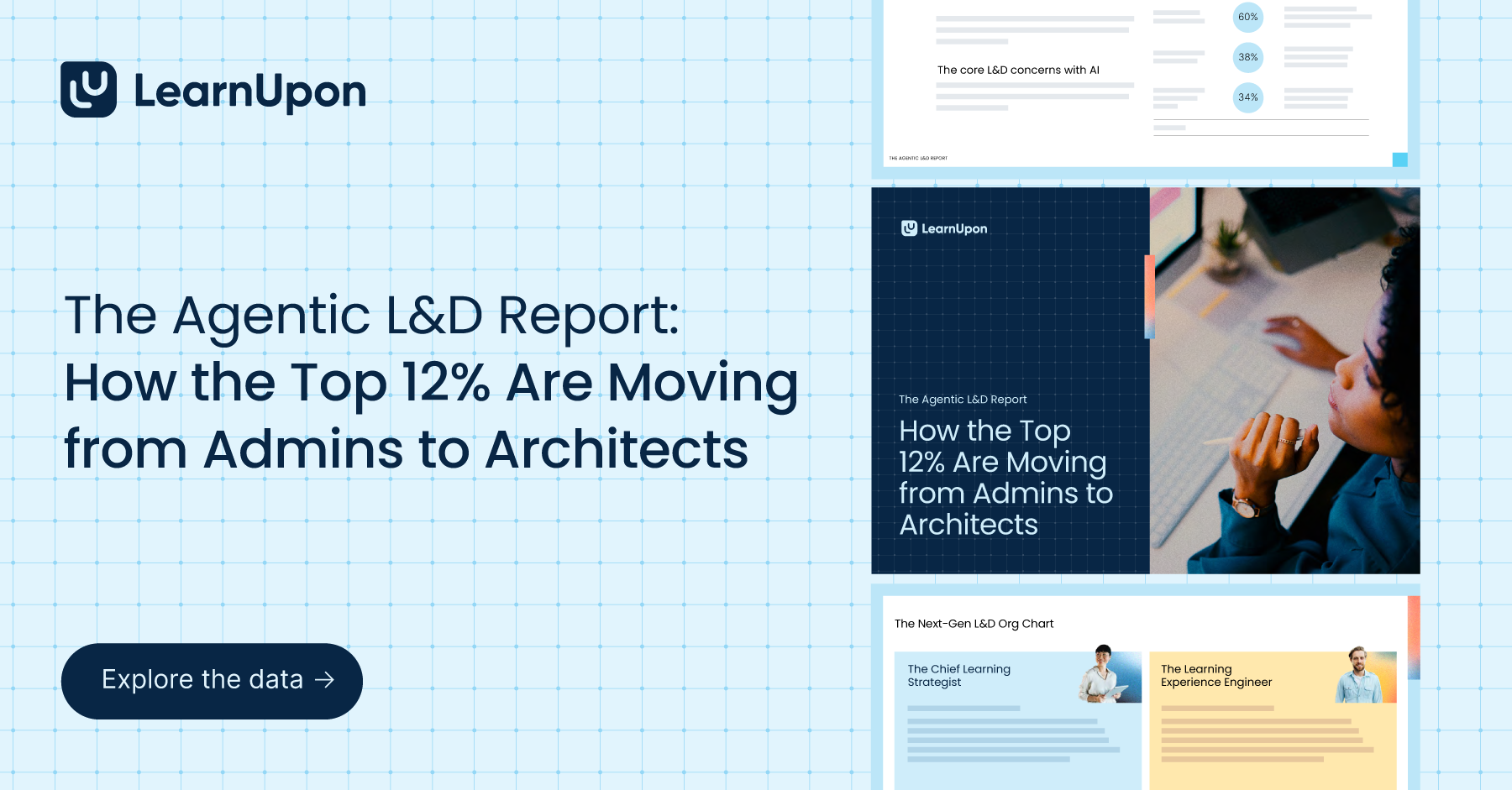
You can also explore our most recent report, which explores how L&D teams are navigating the shift to Agentic Learning—and what it takes to move from AI experimentation to intentional, strategic adoption:
Q&A
Question: What advice do you have for leaders navigating the evolution of L&D?
Short answer: Start by identifying where administrative friction holds your team back. Embracing AI in learning isn’t about replacing people; it’s about eliminating manual logistics so your team can confidently step into modern, future-proof L&D roles that drive organizational growth. Evolving your L&D function doesn’t need to be overwhelming—it’s simply about unlocking the full potential your team already has.
Question: What is agentic learning, and how is it different from just “adding AI” to existing L&D workflows?
Short answer: Most of us are already familiar with standard AI that waits for a human prompt to complete a single, isolated task, like summarizing text. An agentic approach introduces autonomous AI agents capable of goal-directed action. Instead of simply adding AI as an afterthought, agentic learning leverages specialized tools that can independently execute multi-step workflows—like launching personalized development paths or acting as a real-time conversational guide—all while keeping human strategy firmly in control.
Question: How does an Agentic Learning Platform differ from a traditional LMS?
Short answer: A traditional LMS serves as a reliable, foundational system built to secure content, track compliance, and manage records. An Agentic Learning Platform, like LearnUpon’s, doesn’t replace that stable system; it builds upon it. By layering autonomous AI agents and ecosystem integrations directly into your learning environment, an Agentic Learning Platform transforms the system into an active partner that handles heavy administrative workflows for admins and delivers hyper-personalized experiences for learners.
Question: Is AI going to replace L&D roles?
Short answer: No. At LearnUpon, we see the future as being intelligent, not artificial. The real challenge facing the industry isn’t role replacement; it’s friction. When used intentionally, agentic technology handles the repetitive system noise so that your L&D roles can evolve away from baseline maintenance and toward high-impact strategic ownership, brand governance, and deeper human connection.